We are influencing public policy and perceptions so that everyone in Scotland has access to good person-centred social care support.
Social care should matter to you
Most of us in Scotland will need social care support one day or we will support others at some point in our lives. That might look like someone helping us to get out of bed in the morning, or to support us to meet up with our friends, or to be alongside us as we go through tough times with our mental health. This is social care.
Social care is kind of like scaffolding. It holds us up so we can build or rebuild our lives no matter the challenges we might face. We want that scaffolding to be there – whether we or someone we love needs it now or in a few years’ time. Because it’s likely we will need it.
If Scotland makes social care more of a priority, we’re making it easier for all of us in Scotland – to live well, and to do the things we want to in life alongside people that matter to us. That’s something we can all get behind.
Carr Gomm’s calls for the next Scottish Government
Carr Gomm is not party political and does not tell people who to vote for. However, we do want politicians to understand the importance of social care as they make decisions that affect the people we support and our staff. As we approach the Scottish Parliament elections, we’re calling on our politicians to make social care a priority. Carr Gomm is encouraging the next Scottish Parliament to:
- Invest fairly across the social care workforce
- Recognise the impact of not-for profit providers & potential for cross-sector partnerships
- Ensure everyone who needs it has the right to good quality social care when it’s needed.
Over the coming year, we will be sharing these messages and working with politicians to ensure that people who have social care in their lives are given greater priority by the next Scottish Government.
The Scottish Parliament Elections – What you can do
If you want to help Carr Gomm encourage Scotland’s politicians to make social care a priority, engaging in the Scottish Parliament elections is a great way to do this.
1. Read up on what the parties say about social care.
It’s a great idea to get informed about what parties are saying about social care. Does the parties who want to represent you mention social care in their manifestos or in any of their advertising. Do their policies feel like they would help build a better future for people who need social care support?
2. Get in contact with your local MSP candidates.
In the run-up to the elections, MSPs and candidates are out-and-about engaging with potential voters and listening to the issues that matter to them. If social care matters to you or someone you care about, you can let share this with your local MSP candidates. You might want to discuss with them the policies they have on social care in their manifesto. You can do this by:
- Sending them an email or letter
- Attending a political hustings
- Speaking to them if they visit your neighbourhood.
You can find your local MSP candidate and how to contact them on the Who Can I Vote For website.
3. Encourage your elected MSP to stay focused on social care.
It’s easy after an election for politicians to have lots of different causes and concerns on their agenda. To make sure improving the social care system remains a priority, continue to encourage your local MSP to call for better investment in social care so that everyone in your community can live well and thrive at home.
The last year in influencing change in social care
- The Scottish Government invited Carr Gomm’s National Involvement Group, a group of people we support, as well as anyone supported by Carr Gomm to provide feedback on important social care issues. They have met regularly with key Civil Servants to share their views on current policies and explore improvements to ensure everyone in Scotland gets the right support to live well.
- We met with Tom Arthur MSP, the Minister for Social Care and Mental Wellbeing, in 2025. He learned about our services helping people across Scotland live independently and achieve goals. We discussed the importance of good conversations among politicians, social care providers and the public about the future of social care. We highlighted barriers to accessing quality social care and asked for his help to remove them.
- We responded to the Scottish Government’s 2026/7 budget, which reduced the funding given for providers to pay the Real Living Wage. We sent a letter to the Minister for Social Care, Tom Arthur, and other MSPs across political parties, urging them to support the full funding of the Real Living Wage in the budget. This funding was given as a result of the campaigning from Carr Gomm, CCPS and other social care providers.
- We have acted where decisions are being recommended or made locally that threaten people’s rights to good quality social care. In Argyll & Bute, we have worked with Argyll & Bute Council and the Argyll & Bute Health and Social Care Partnership, to ensure that people in the region can continue to have a Responder Service which enables them to live in their own home and reduces their likelihood of being admitted to hospital unnecessarily.
- Through our Community Contacts Project, we are continuing to ensure that Self-Directed Support is implemented well in Scotland so that everyone can have choice and control over how their care and support is arranged.
Follow us
To stay up to date with our Influencing work, follow us on:
Carr Gomm’s Influencing Change Blog
Ending the health and social care relay race
If you’ve not watched our feature on Darren McGarvey’s: The State We’re In, you can still catch it on BBC iPlayer. If you have watched it, you will have noticed how many questions the programme raises about why health and social care is in the state it’s in. Questions...

Carr Gomm on the BBC
Carr Gomm features in a new three part, UK-wide BBC documentary – Darren McGarvey: The State We’re In. Carr Gomm welcomed Scottish rapper and social commentator, Darren McGarvey to Carr Gomm as he spent a day on shift with our Dunoon Mobile Homecare Responder...
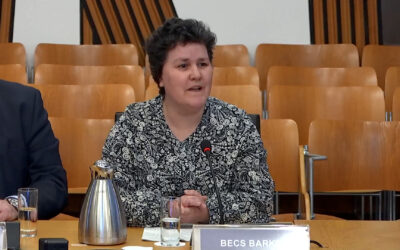
Carr Gomm’s Becs Barker gives evidence to the Scottish Parliament on SDS
Becs Barker, Carr Gomm's Operations Manager for Community Contacts, Involvement, Quality and Innovation, gave evidence on behalf of social care providers on whether Self-Directed Support (SDS) has achieved its ambitions in Scotland. SDS was brought in as the primary...
Scottish Minister responds to Carr Gomm’s call for social care wage uplift
Maree Todd MSP (Minister for Social Care, Mental Wellbeing and Sport) has responded to Carr Gomm’s letter which calls for the Scottish Government to close the unjust pay gap between workers employed by commissioned providers and equivalent workers employed by the...

Has Scotland’s Self-Directed Support Act achieved its ambitions?
Carr Gomm, our National Involvement Group and the Community Contacts project have shared with the Scottish Parliament whether Self-Directed Support Legislation (SDS) has realised its aims. SDS aims to give people as much choice and control as they want about how their...
Social Care Wage Uplift – Letter to the First Minister
Lucy Wren, our Chief Executive, has written to the First Minister calling for the Scottish Government's Fair Work agenda to be realised in social care. As our letter explains, the Scottish Government's continued funding of social care wage policy at the minimum level...

Will a National Care Service recognise digital inclusion as a human right?
Shannon McNee, our Digital Inclusion Development Manager, asks how a National Care Service can recognise digital inclusion as fundamental to people's human rights. Disabled people, and those living with long-term conditions, are significantly more likely to face...

It’s time to change the narrative on ‘bed blocking’
The phrase ‘bed-blocking’ is currently bandied around in the media as people try to make sense of increasingly long A&E waiting times and surgery cancellations. When you stop to think about this phrase, it conjures up images of people (probably elderly) refusing...

Does the way we access social care in Scotland work?
Becs Barker Operations Manager for Community Contacts, Involvement, Quality and Innovation. asks: Does the way we access social care in Scotland work?